Bar vs Table: Which Taproom Guests Spend More?
Taproom service models come in all shapes and sizes. However, when it comes to where your guests settle in your taproom, it typically comes down to two primary options: the bar or table. And while we’ve seen the rise of technology in the taproom, ultimately, the guest is typically ordering at the bar or at the table. Today, we’re going to look at the impact of spending based on where a guest sits and orders from. As someone who preaches the importance of human connection, I come into this with the hypothesis that the more opportunity a taproom team has to engage, the more a guest will spend.
When we first started collecting taproom data, we only asked guests, “where did you sit?” In early 2026, we added the data point, “where did you order from?” Before we dive into the data, there’s an important observation to make. Larger parties typically order and sit at a table. Smaller parties are more likely to order and sit at the bar.
Let’s first look at the impact of where a guest sits on spend.
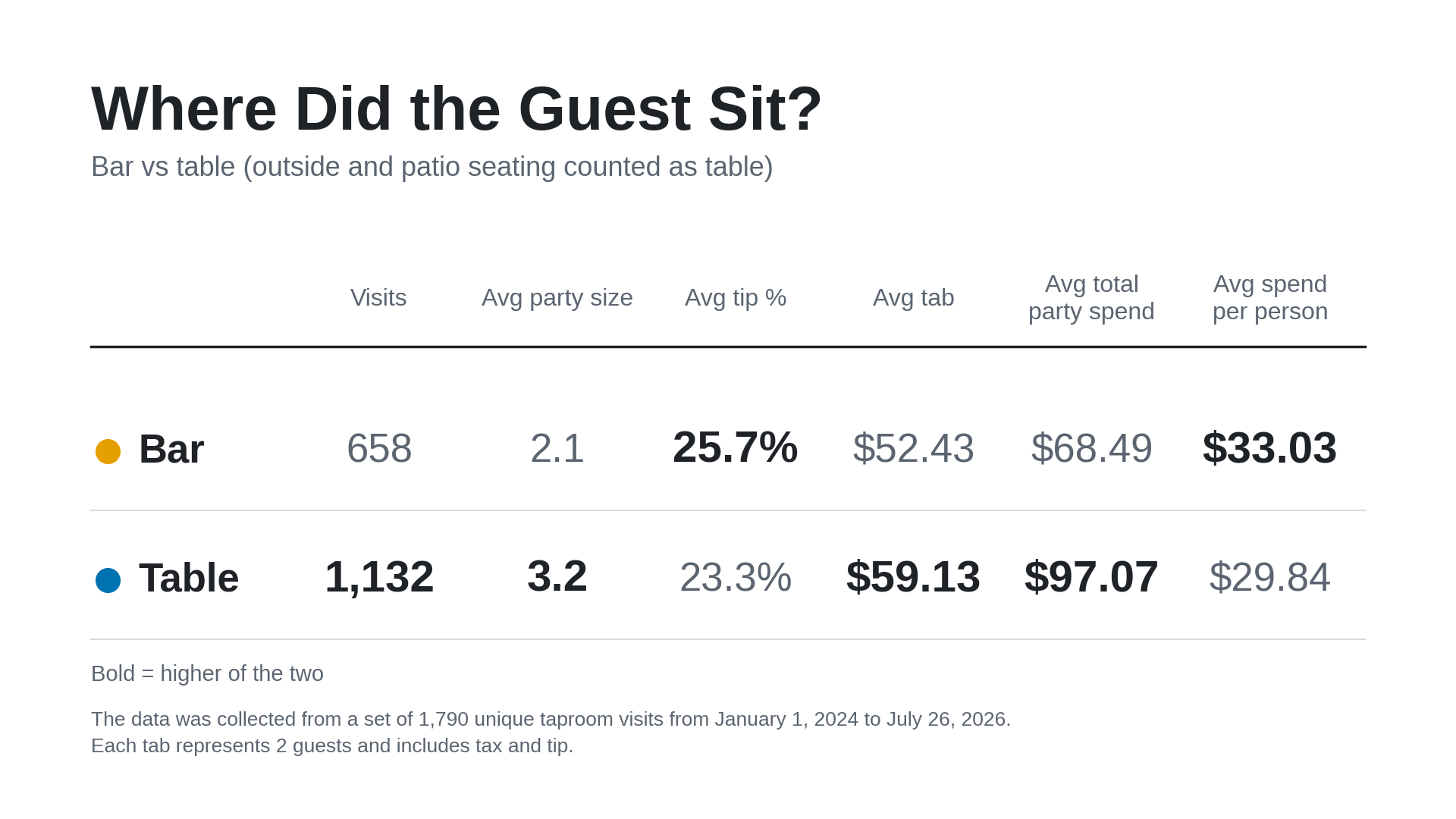
The average party at a table is over 55% larger.
The average tab at a table is 13% higher ($59.13 vs $52.43).
Total party spend at a table is 42% higher ($97.07 vs $68.49).
Bar guests spend more per person ($33.03 vs $29.84).
Guests tip 10% higher when sitting at the bar.
Now how about any trends based on where they order?
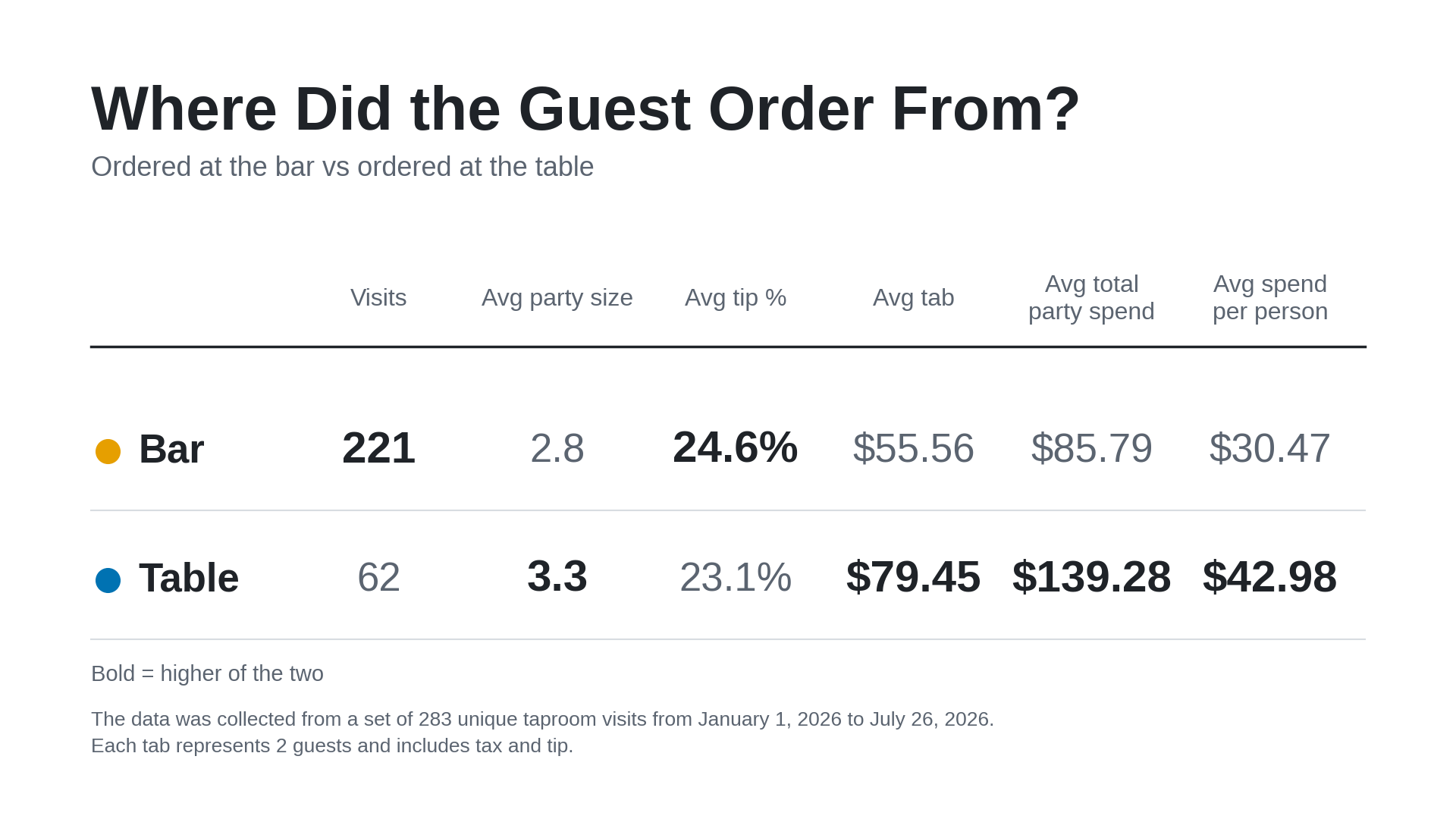
The average guest ordering at the bar still tips higher (24.6% vs 23.1% for guests ordering from a table.
When a guest orders from a table, the average party size is 3 guests, and the spend per person is a whopping 41% more than the guest who orders from the bar.
Despite the impressive impact of ordering from a table, nearly 80% of guests in the study ordered from the bar.
But Andrew! Sometimes a guest orders at the bar, but sits at a table! What about these scenarios?
Guests who both order and sit at the bar still tip the highest percentage.
The highest tabs/total party spend come from those guests who order/sit at a table. After all, how many people order at a table…then sit at the bar?
The guest who orders/sits at a table spends 58% more than the guest who orders at the bar and sits at a table.
Nearly 50% of guests who order at the bar sit at a table and they have the lowest spend per person ($27.38 vs $33.44 and $43.22).
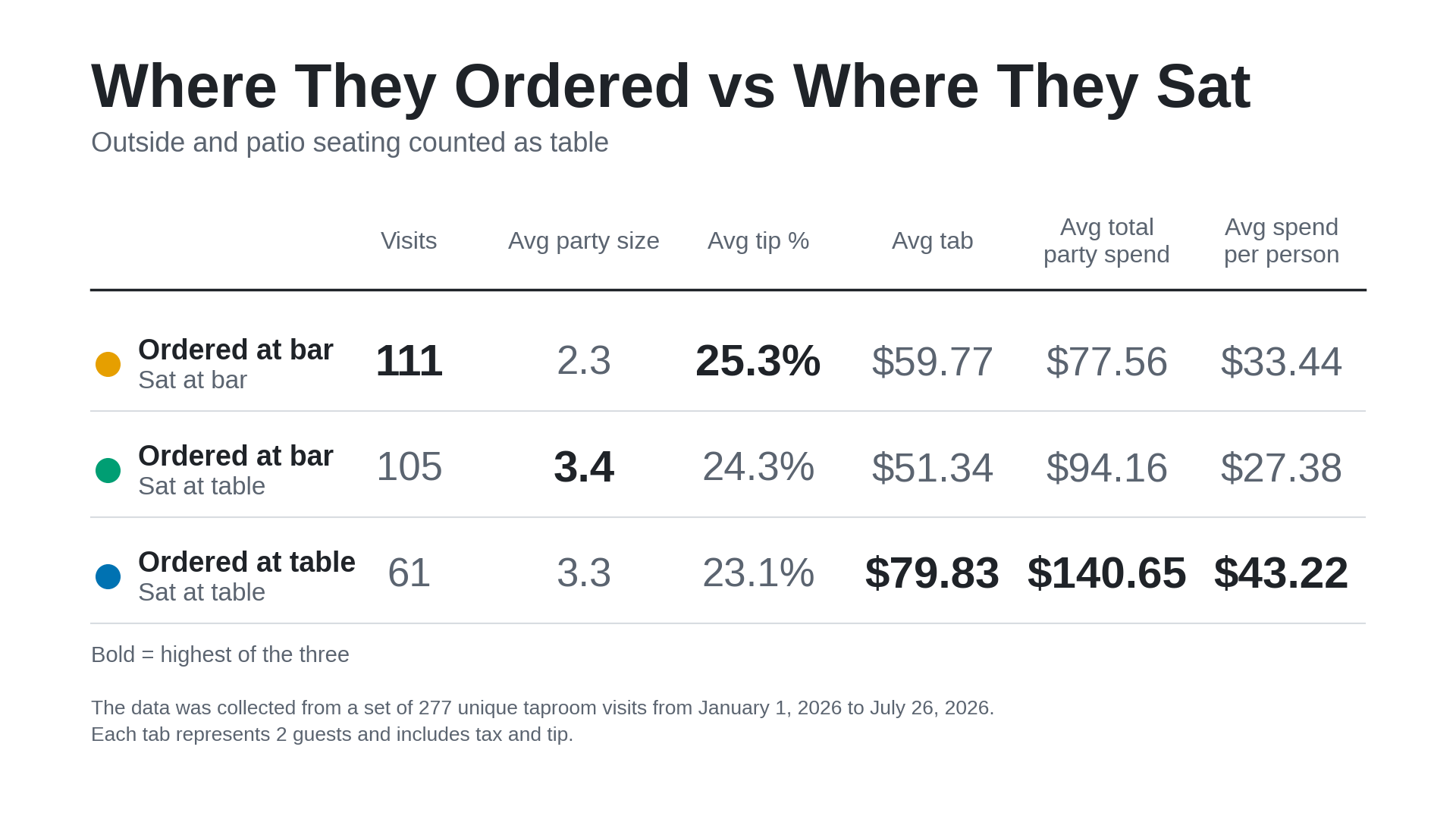
Table service is where the money is. Ordered at table, sat at table has the biggest tab, spend per person and total spend by a wide margin. Nearly 40% of visits order at the bar and stay at a table, and they spend the least per person. Those guests rate engagement high less often too. This is money left on the table. Once a guest orders at the bar, then ventures to a table, they may not have any prompts to enjoy more of your delicious beverages and food options.
“But Andrew! We can’t find quality staff, we’re short-staffed!” My response? It only takes a second. I’m not telling you that you have to offer table service. That’s your call. But if you don’t, you should have a staff member step out from behind the bar to check on guests. I don’t recommend offering them table service when it’s not part of your business model, but rather, use the touchpoint to remind them how your taproom works.
A few phrases to try out:
Reminder: “Hope you’re having a great time. Just a reminder, we’re up at the bar if you need anything else.”
Recommendation: “Looks like you really enjoyed the ______. If you want to try something different, come up and we’ll point you to your next one.”
Reorder: “Looks like you’re ready for another. Come up to the bar and we can take care of you.”
Are you table-service-curious? Here are a few ideas to test the waters.
Pick a day to test it out.
Depending on the size of your taproom, consider offering it to everyone (if small-ish) or to a specific section.
When interacting with guests, let them know upon entry that you’re testing out table service today, and explain how/where it’ll work.
When letting guests order from the table, remind them that you all are testing out the model, and to not expect it (just yet) in the future.
When they’re closing out, thank them for being part of the test run, and ask for any feedback on the table service experience.
On your end, ask yourself?
Does table service even make sense for my taproom?
What did the guests say?
What does the data say? Does it match the expected increase in spending from our data?
Can you maintain table service? Do you have the staff to offer it? Will you always be able to provide consistent table service experiences?
Sitting at a table doesn’t raise spend per person. Bar guests actually spend about 10% more each. Ordering at a table does, increasing spend per person by about 40%. Ultimately, it comes down to the quality of your team’s interactions with guests. Guests at the bar rate their staff’s engagement as high more often (51% vs 44% at a table), and they tip more. In both locations, guests who rate their staff’s engagement as high tip more. The better a staff member engages, the higher the guest tips.
Guests are coming to your taproom for human connection. Don’t just provide them with a high-quality product, give them a high level of hospitality that will not only make them return sooner, but also spend more.
If you found this article helpful, please share it with someone who’d also find value. Thank you for reading.
The data was collected from a set of 1,790 unique taproom visits from January 1, 2024 to July 26, 2026. Each tab represents 2 guests and includes tax and tip. Where guests ordered from was added in January 2026, so those results cover 277 of these visits.